Three unannounced KADIZ entries in eight days fuel debate over Moscow's intentions, amid shifting regional security dynamics
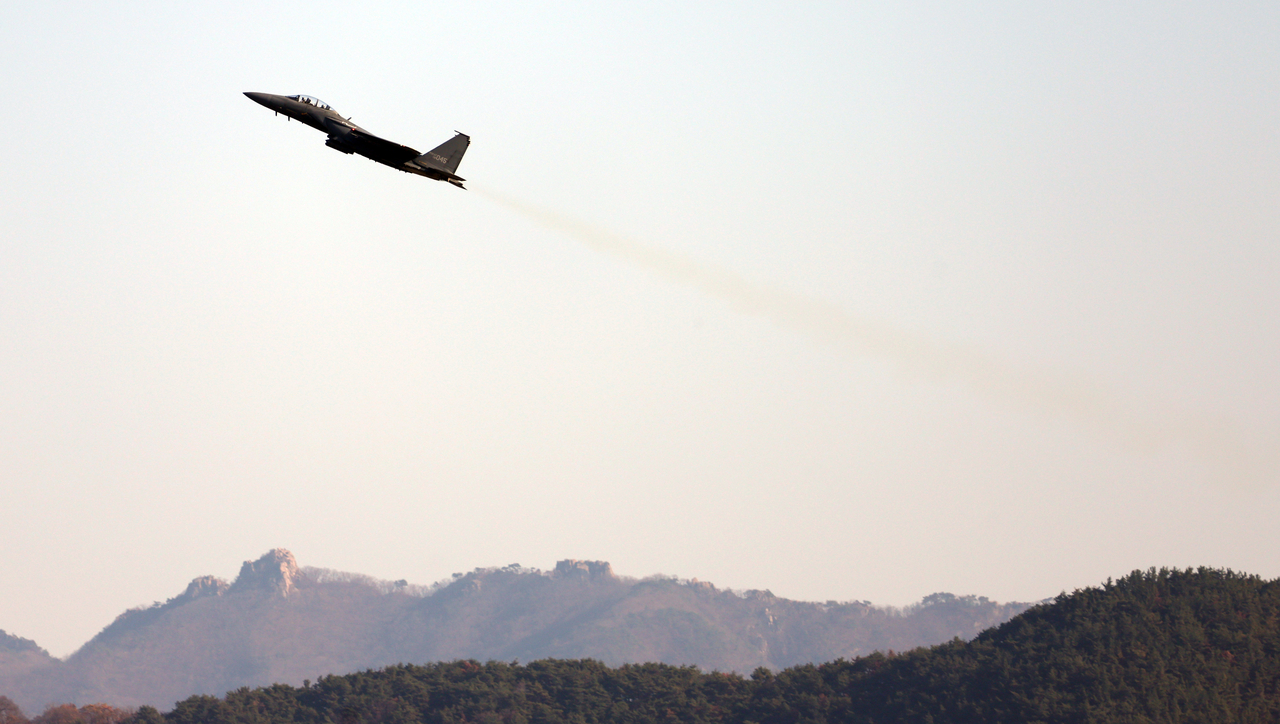
Russian military aircraft entered South Korea's air defense identification zone without prior notice Tuesday for the third time in eight days, raising questions over whether Moscow is stepping up military signaling toward Seoul and Washington.
The latest incident prompted South Korea to scramble fighter jets and issue an emergency warning to residents of the North Gyeongsang Province island Ulleungdo in the East Sea, although the Russian aircraft did not violate the country's sovereign airspace.
According to the Joint Chiefs of Staff, fewer than five Russian military aircraft entered the Korea Air Defense Identification Zone, or KADIZ, early Tuesday, approaching the island before changing course following the South Korean military's response.
The Defense Ministry summoned the Russian defense attache on Tuesday to lodge a protest over the unannounced entry.
Asked by reporters upon arriving at the ministry whether the entry was deliberate and whether he had been aware of it in advance, the attache replied, “No comment.”
While Tuesday's incident followed similar entries on Nov. 17 and 19, Russian military flights into KADIZ are hardly unprecedented.
According to Defense Ministry data obtained in 2024 by Rep. Boo Seung-chan of the Democratic Party of Korea, Russian military aircraft entered KADIZ fewer than 10 times in 2020, around 10 times in 2021, around 20 times in 2022 and around 10 times in 2023.
Unlike sovereign airspace, an air defense identification zone is designated to facilitate the early detection of approaching aircraft. South Korea requires foreign military aircraft to provide advance notice before entering KADIZ, but Russia does not recognize the requirement.
What remains unclear is whether the recent concentration of Russian flights reflects routine military operations or a more deliberate attempt to exert geopolitical pressure.
Pressure on Seoul?
Experts have suggested that Moscow could be seeking diplomatic leverage over Seoul amid tensions over Russia's war against Ukraine and its deepening military partnership with North Korea.
“Russia may have something it wants from South Korea, possibly related to sanctions relief or Ukraine, and it may be communicating those demands behind the scenes,” said Shin Beom-chul, a senior research fellow at the Sejong Institute and former vice defense minister.
Shin added that the flights could reflect growing geopolitical divisions in Northeast Asia, with South Korea, the US and Japan strengthening security cooperation as North Korea draws closer to Russia and China.
Seoul, Washington and Tokyo have increasingly institutionalized their security partnership since the 2023 Camp David summit, holding the fourth iteration of their multidomain Freedom Edge exercise in September.
Meanwhile, Pyongyang signed a mutual defense treaty with Moscow in 2024 and subsequently deployed troops to support Russia's war against Ukraine. North Korean leader Kim Jong-un also stood alongside Chinese President Xi Jinping and Russian President Vladimir Putin at a military parade in Beijing in September last year.
A message to Washington?
Park Yong-han, a senior researcher at the Korea Institute for Defense Analyses, suggested that Moscow could be seeking to demonstrate its defense commitments to Pyongyang or counter US military activity in the region.
“It could also be seen as Russia mirroring the deployment of US strategic assets around the Korean Peninsula,” Park said.
The Russian flights come as military operations involving US forces stationed in South Korea increasingly extend beyond the peninsula.
On Monday, US Forces Korea announced that the 2nd Infantry Division's 2nd Combat Aviation Brigade had deployed helicopters to Japan for live-fire training, marking the brigade's first such overseas exercise.
“KADIZ is also an area where US military assets operate, so we should leave open the possibility that Russia is sending a message to Washington,” Park said.
He cautioned, however, against interpreting the flights alone as evidence of a firmly established military bloc involving North Korea, China and Russia.
Routine flights or deliberate provocation?
Other experts cautioned against reading too much into the recent flights, given their historical frequency and the ambiguous legal status of air defense identification zones.
“These flights can be regarded as routine. Air defense identification zones do not have a clear legal standing under international law, and military flight plans are often prepared well in advance,” said an official affiliated with a military intelligence institution, who requested anonymity.
Another official at the same institution argued that the absence of a clear international legal framework did not justify disregarding South Korea's air defense procedures.
“KADIZ is not really something that can be negotiated away, because it represents the minimum area South Korea considers necessary for its air defense,” the official said. “Providing advance notice before entering is simply a matter of basic courtesy.”
flylikekite@heraldcorp.com