
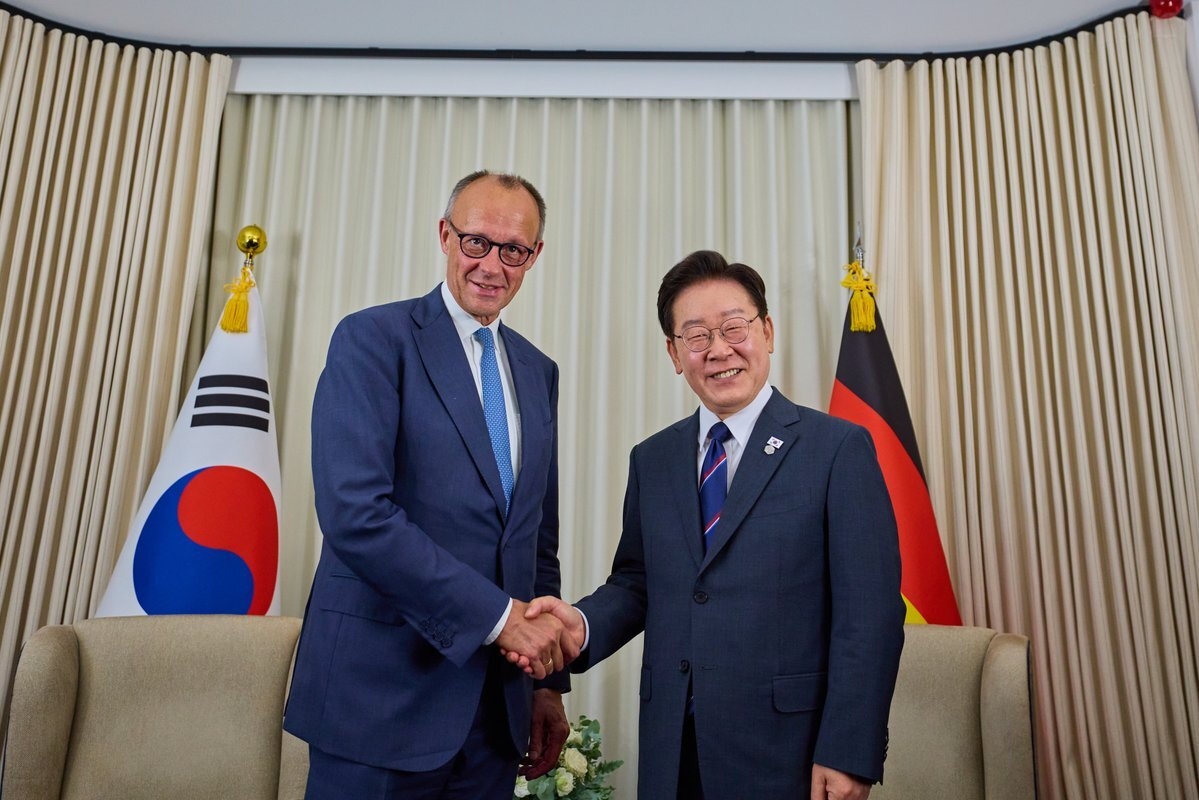
Securing critical supply chains in key industries and expanding high-tech cooperation sit high on the agenda as President Lee Jae Myung and German Chancellor Friedrich Merz pursue stronger South Korea-Germany relations, according to Seoul.
Lee is scheduled to host Merz at Cheong Wa Dae in Seoul on Thursday afternoon, with renewable energy, power grids and defense also among the areas of potential cooperation.
The two manufacturing powerhouses face growing pressure to diversify supply chains and safeguard their industrial competitiveness amid global economic and security uncertainties.
The meeting coincides with Merz's visit to Seoul for the 19th Asia-Pacific Conference of German Business, or APK, one of Germany's largest public-private business forums aimed at strengthening economic ties with the Asia-Pacific region. Seoul is hosting the conference for the first time since 2007.
The summit is expected to cover “ways to deepen future-oriented cooperation across various fields, including political affairs, the economy, defense and the defense industry, science and technology, and people-to-people exchanges,” senior presidential spokesperson Kang Yu-jung said in a press statement.
The talks are also expected to focus on “laying the groundwork for a new leap forward in bilateral relations” between Seoul and Berlin, Kang added.
Kang underlined that Merz's visit would serve as “an important opportunity to turn new challenges arising from the rapidly changing global security and economic environment into opportunities for mutually beneficial cooperation” between the two countries.
The visit also offers an opportunity for “sharing the two leaders' strategic perspectives on major regional and global issues, and further strengthening coordination,” she added.
The two leaders are expected to discuss “ways to stabilize supply chains in key industries, including semiconductors, batteries and artificial intelligence, and strengthen cooperation in advanced technologies” with Germany, South Korea's largest trading partner in Europe, Kang said.
The talks are also expected to address “expanding technological and industrial cooperation in renewable energy and power grids, as well as creating a more favorable institutional environment for business activities,” she added.
Germany is South Korea's largest trading partner in Europe and a key gateway to the European Union market. Around 850 Korean firms operate in Germany, while German companies maintain a strong presence in Korea's automotive, machinery and industrial technology sectors.
The push for closer cooperation comes as both countries seek to reduce their reliance on China for critical industrial materials. Beijing's export controls on rare earths and other minerals have exposed vulnerabilities in European manufacturing supply chains, while South Korea remains heavily dependent on Chinese battery materials, including graphite and cathode precursors.
Defense cooperation is another area the two leaders are expected to explore.
Kang said the two sides would also “explore potential areas of cooperation in defense and the defense industry and exchange views on ways to establish an institutional framework to support sustained cooperation.”
The discussions come as Germany ramps up military spending amid the war in Ukraine and mounting European security concerns, potentially opening opportunities for South Korean defense firms in artillery, armored vehicles and air defense systems.
South Korea's partnership with NATO, formalized through an Individually Tailored Partnership Programme in 2023, provides an existing framework for defense industrial cooperation. Closer ties with Germany, one of Europe's major defense manufacturers, could pave the way for joint development and production beyond individual arms deals.
The summit marks Merz's first official visit to South Korea since taking office and the first bilateral visit by a German chancellor in three years.
Lee and Merz last met in June on the sidelines of the Group of Seven summit in France, with Thursday's meeting marking their third summit since Merz took office in May 2025.
Lee is also scheduled to host an official dinner for about 60 guests, including members of the German business delegation and leading South Korean executives, to promote bilateral economic cooperation. The dinner has been prepared on a scale comparable to a state banquet, according to the presidential office in Seoul.
South Korean attendees are expected to include Korea International Trade Association Chairman Yoon Jin-sik, Hyundai Motor Group Executive Chair Chung Euisun, POSCO Group Chairman Chang In-hwa, Hyosung Group Chairman Cho Hyun-joon and HL Group Chairman Chung Mong-won.
The presidential office said the dinner is intended to foster exchanges between the two leaders and business executives and strengthen networks between the countries' business communities.
dagyumji@heraldcorp.com


