New factory strengthens Korean automaker's domestic production, export ambitions, as it marks 30 years in India
PUNE, India — Hyundai Motor is stepping up its India expansion with a new factory in Pune, bringing its annual production capacity in the country close to 1 million vehicles, as the South Korean automaker strengthens its foothold in the world's third-largest auto market.
Built on the site of a former General Motors plant acquired in 2023, the facility is central to Hyundai's strategy to make India both a major production base for domestic sales and an export hub serving emerging markets.
The expansion comes as Hyundai marks 30 years in India, where it has grown into the country's second-largest automaker and established one of its most important overseas manufacturing bases.
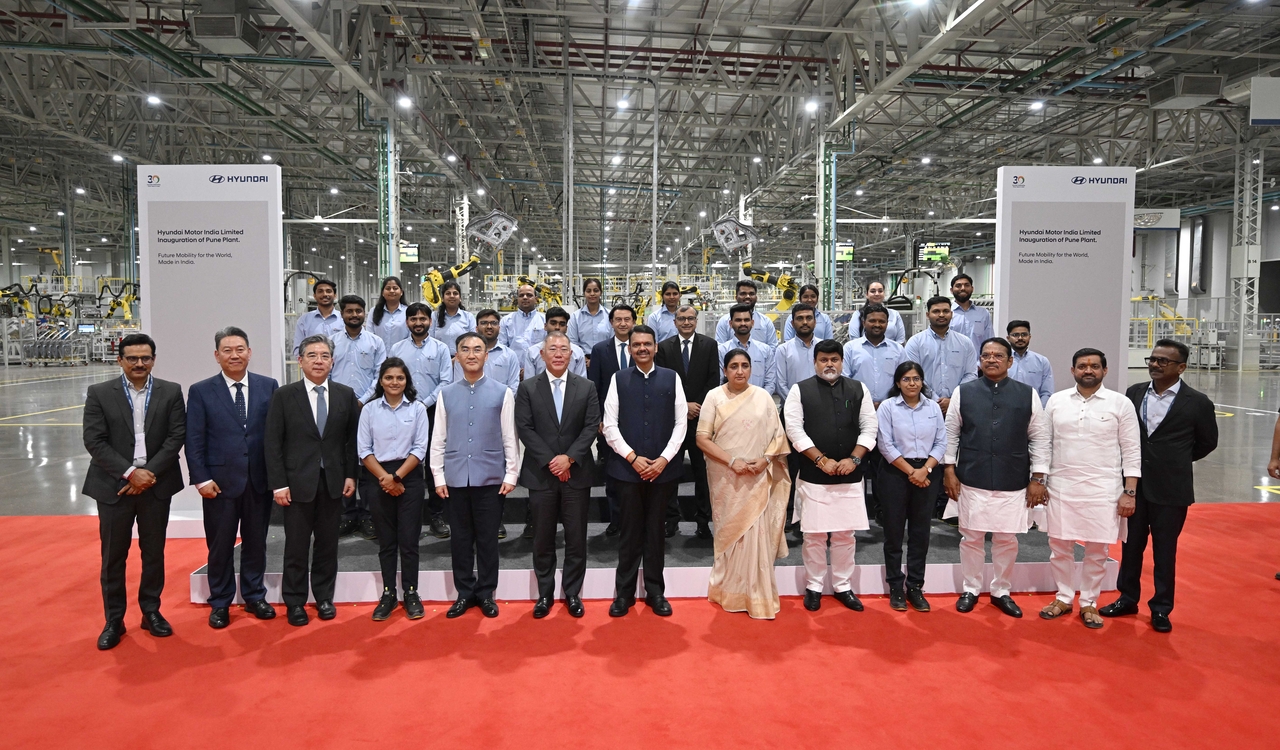
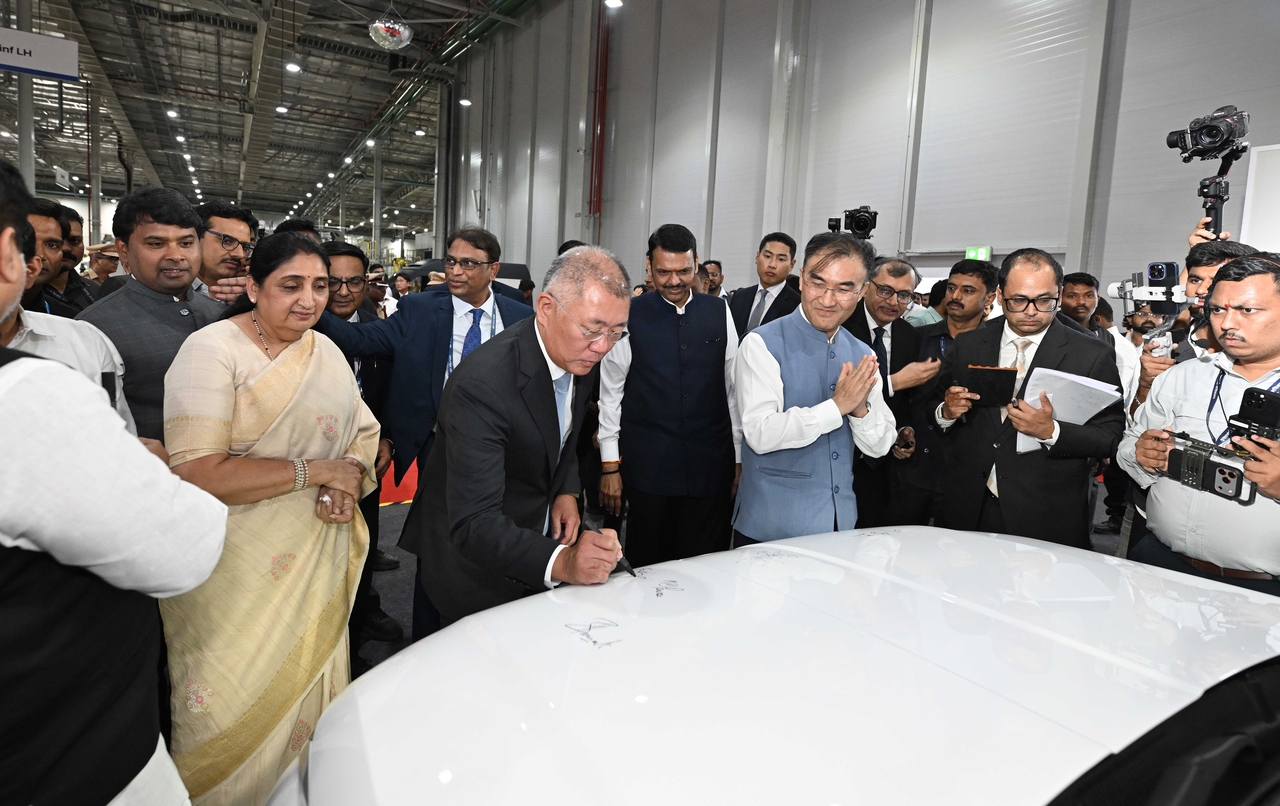
Hyundai officially inaugurated the Pune plant Wednesday in a ceremony attended by Hyundai Motor Group Executive Chair Chung Euisun, Hyundai Motor CEO Jose Munoz and senior Indian government officials, including Maharashtra Chief Minister Devendra Fadnavis.
In a stand-up interview with media, Chung said he discussed broadening Hyundai’s footprint in India well beyond passenger cars during his meeting with Prime Minister Narendra Modi in New Delhi. The talks covered public transportation -- including buses and subways -- as well as infrastructure, clean energy, robotics and AI.
On manufacturing technology, Chung noted that the new Pune facility and other upcoming plants will heavily deploy AI, particularly for quality inspection and control.
Addressing the country’s EV transition, Chung highlighted charging infrastructure as a primary bottleneck that requires broad industry collaboration. “We need to join forces with other companies, including both global peers and Indian automakers,” Chung said, adding that Hyundai plans to incorporate more locally manufactured components to accelerate battery production and supply chain localization.
India nears 1 million capacity
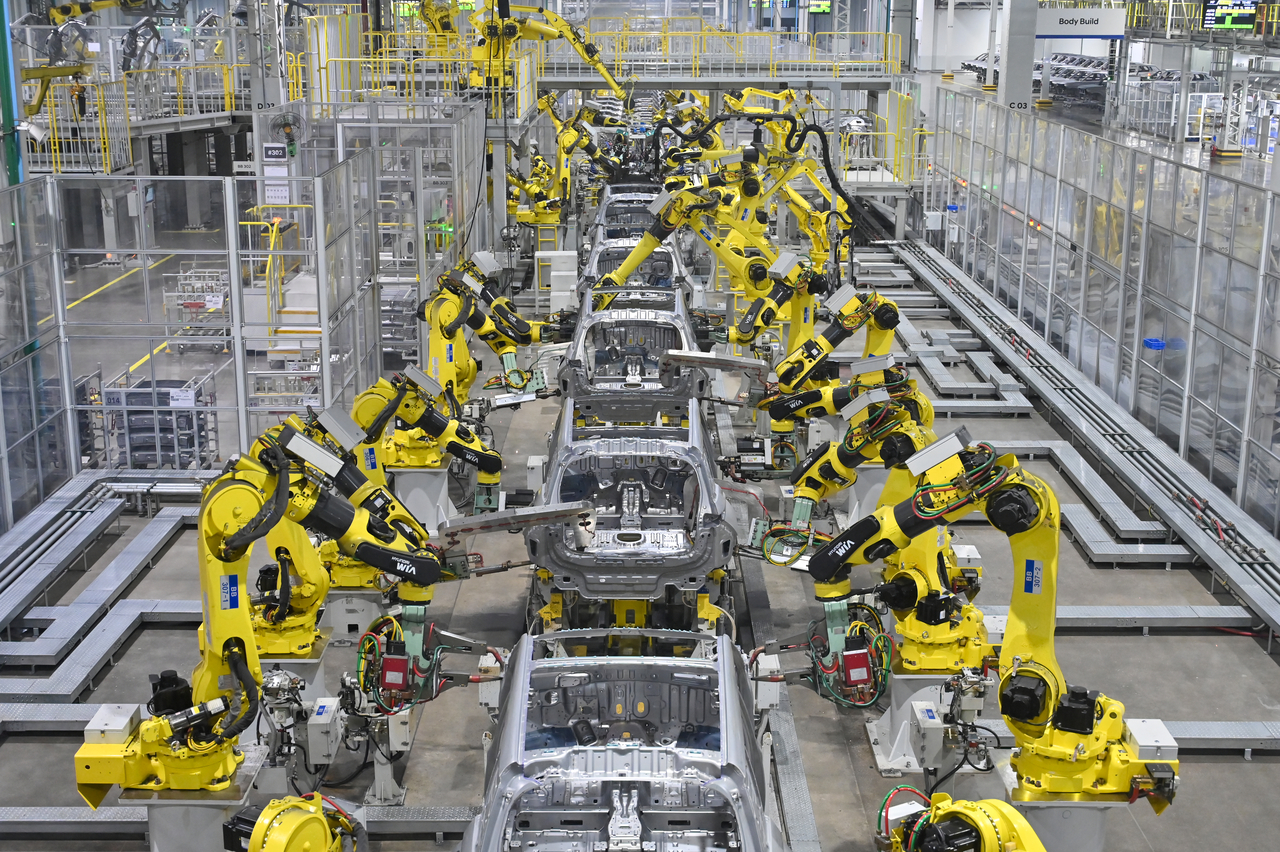
The new plant begins with an initial annual capacity of 170,000 units, with plans to ramp up to 250,000 units within two years and 320,000 by 2030. Alongside its two Chennai plants, which together produce 824,000 units, Hyundai’s annual capacity in India now approaches the 1 million mark.
The expansion also boosts the groupwide output. Together with Kia’s Anantapur facility, Hyundai Motor Group’s overall capacity now stands at 1.42 million units annually and projected to surpass 1.5 million units after 2028.
While the Pune plant will eventually add hybrid models to its assembly lines, its initial output is led by the second-generation All-New Venue compact SUV, targeting the domestic market and export to over 30 countries across Latin America, Africa and the Middle East.
Since its launch in 2019, the Venue posted 802,221 sales in India through May this year, with overseas shipments increasing global cumulative sales to past 850,000 units.
By taking over Venue production, the Pune plant frees up Chennai’s lines to accelerate EV output, aligning with the Indian government’s push for 30 percent EV sales by 2030. Building on the Ioniq 5 crossover SUV and Creta Electric compact SUV, Hyundai plans to launch a dedicated compact electric SUV tailored for the Indian market early next year.
Second-largest export hub
The new Pune facility accelerates Hyundai’s push to turn India into a key global export hub. Backed by the plant’s projected annual capacity of 320,000 units, Hyundai Motor India plans to lift its export share to 30 percent of total production by 2030.
The milestone comes as Hyundai’s local subsidiary surpassed 4 million cumulative passenger vehicle exports since 1999, cementing its position as India’s top auto exporter and the first to achieve that milestone. India already serves as Hyundai’s second-largest overseas export base behind Korea, with its Chennai complex having shipped more than 3.7 million units across 150 countries through July 2025.
Industry insiders note India offers Hyundai a chance to re-create the powerful economies of scale that once drove its sharp rise in China, but with substantially greater strategic advantage and minimal geopolitical risks.
But unlike its early China playbook, which capitalized on explosive domestic demand, India represents a more balanced, dual-track hub that combines strong local sales with an export base to the Global South for more stable, long-term growth.
Deepening localization
Hyundai’s commitments to India came early on when it became the first foreign company to establish a wholly owned manufacturing plant in India in the 1990s.
In 2024, Hyundai Motor India made a landmark market debut on the National Stock Exchange of India, marking the largest initial public offering in the country’s history and becoming the first overseas subsidiary of a Korean company to go public globally.
These deep localization strategies have fortified the group’s Indian foothold. Last year, Hyundai Motor Group sold 852,164 units, securing 18.7 percent market share as the second-largest automaker behind Maruti Suzuki.
“Today’s inauguration marks a new chapter in our journey with India,” Chung said in his opening speech. “Since the launch of the Hyundai Santro, India has become a key pillar of Hyundai’s global success. … We are now advancing from ‘Make in India’ to ‘Design in India’ and ‘Innovate in India.’ Today’s inauguration reflects our strong confidence in India’s future.”
Hyundai Motor Group’s aggressive expansion in India is also providing a major growth engine for its domestic supply chain partners. Around 120 Korean auto parts suppliers now operate in India alongside Hyundai and Kia, nearly doubling from 68 in 2011 when Hyundai operated only in Chennai.
With the launch of the Pune plant, the local footprint of these suppliers has widened, turning the country into one of Korea’s key auto parts export destinations, reaching $841 million last year as the fifth-largest bilateral trade item.
hyejin2@heraldcorp.com