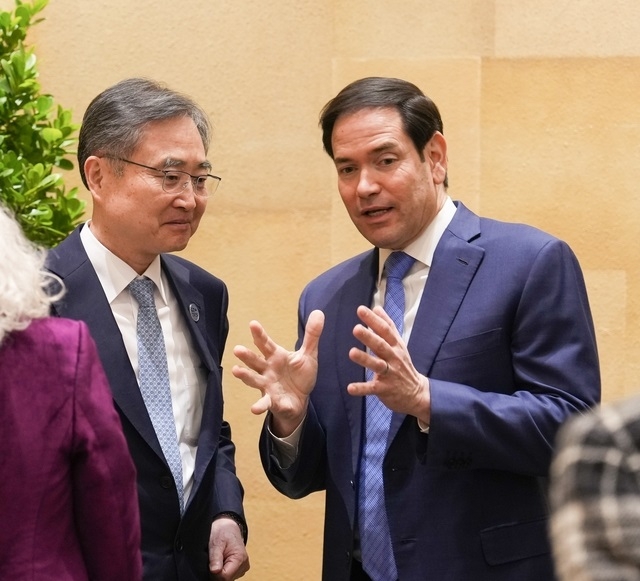
Foreign Minister Cho Hyun is expected to meet US Secretary of State Marco Rubio in Washington on Friday, as Seoul faces pressure over a potential military deployment to the Strait of Hormuz and seeks to advance unresolved security issues with Washington.
Should the meeting take place, it would mark the first formal bilateral talks between the two foreign ministers in about seven months, following their meeting in Washington in February.
A tentative US State Department schedule published by US news platform Forth lists Rubio as meeting Cho on Friday. According to the schedule, Rubio is due to meet the foreign ministers of Costa Rica, Lithuania and South Korea on Wednesday, Thursday and Friday, respectively.
South Korea's Foreign Ministry said Tuesday that the two sides were making arrangements for the meeting, but did not confirm the date or any details regarding the possible agenda.
"Foreign Minister (Cho) previously said he is planning a face-to-face meeting with (Rubio) by the end of September. Based on this, we are negotiating and making arrangements," ministry spokesperson Park Doo-soon said during a regular briefing.
The talks come at a sensitive time: Seoul is weighing Washington's calls for South Korea to contribute to operations around the Strait of Hormuz, fanning resistance at home, including objections from the main opposition People Power Party and protests by civic groups. The government has repeatedly emphasized that no decision has been made; caution appears to be growing within the ruling bloc over sending South Korean forces to the region, particularly if Seoul were to act without a broader multinational framework.
Even if the government decides to proceed with a deployment, it could face a difficult path through the National Assembly amid opposition from lawmakers in both the ruling and opposition blocs.
The issue has also become diplomatically sensitive following a strong warning from Tehran.
Iranian Foreign Ministry spokesperson Esmaeil Baqaei said in a Korean-language statement posted on X on Sept. 7 that military participation by other countries in the Persian Gulf or the Strait of Hormuz would be regarded as direct support for what Tehran considers aggression and warned that such involvement could have "serious consequences."
Four days later, Cho spoke by phone with Iranian Foreign Minister Seyed Abbas Araghchi at Araghchi's request. Cho told Araghchi during the call that Seoul had made no decision regarding a potential deployment and stressed the importance of restoring freedom of navigation through the Strait of Hormuz as soon as possible, a Foreign Ministry official told reporters.
According to the ministry, Cho also expressed deep concern over the recent situation in the Middle East and voiced hope for the restoration of sustainable peace and stability in the region.
The Hormuz issue is expected to be among a broader set of bilateral and regional issues addressed by Cho and Rubio.
The two are also expected to discuss follow-up negotiations on South Korea's push to acquire nuclear-powered submarines, revision of the bilateral civil nuclear cooperation agreement and the transfer of wartime operational control.
The meeting could coincide with an announcement on the first project under South Korea's investment commitments to the US, which is expected to be finalized this week.
Attention is turning to whether progress on the investment front could help create momentum for the two allies to tackle their broader agenda, including security consultations that have made little headway in recent months.
Ahead of his Washington trip, Cho has also held a series of meetings with figures connected to both the United States and Iran.
On Monday, Cho met three former commanders of US Forces Korea — Robert Abrams, Burwell Bell III and Paul LaCamera — at the Foreign Ministry in Seoul.
Bell commanded USFK from 2006 to 2008, Abrams from 2018 to 2021 and LaCamera from 2021 to 2024. The three are in Seoul to attend the 2026 Korea-US Combined Warfighting Forum on Wednesday.
The Foreign Ministry did not disclose details of their closed-door meeting with Cho. While some speculation has centered on whether the Hormuz issue was discussed, there has been no official confirmation that a potential deployment was raised.
Cho's simultaneous engagement with US and Iranian officials underscores the diplomatic balancing act Seoul faces as it seeks to manage alliance expectations from Washington without further straining relations with Tehran.
The possible meeting could also coincide with the finalization of Seoul and Washington’s negotiations over the first project under South Korea’s investment commitments to the US. Industry Minister Kim Jung-kwan returned to Seoul on Sunday after three days of negotiations in New York, saying the two sides had moved closer to an agreement on many issues but that several points remained unresolved.
Attention has focused on where the first investment will be made under the $200 billion portion of South Korea’s $350 billion investment commitment to the US, excluding the separately allocated shipbuilding investment.
Government officials are expected to brief the National Assembly on the outcome of the negotiations by the end of this week.
mkjung@heraldcorp.com