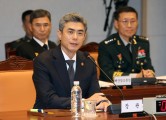


President Lee Jae Myung on Sunday visited the Jeju April 3 Peace Park on Jeju Island to pay his respects to the victims of massacres that erupted on the island on the occasion of the Jeju Uprising in the late 1940s.
During his trip to Jeju, Lee said there would be no place for state violence in South Korea, as he pledged to remove the statute of limitations for cases linked to state violence, including homicide, torture and forced detention.
"In memory of the April 3 Jeju Uprising, I will abolish sunset provisions for a state violence perpetrator's criminal or civil liabilities, to ensure state violence is never repeated," wrote Lee in a visitor's book as he bowed in honor of Jeju massacre victims.
Tens of thousands of Jeju residents are believed to have been killed amid armed conflict between communist rebels and South Korean armed forces that joined hands with United States forces for a violent crackdown.
Against the backdrop of ideological rifts running deep on the Korean Peninsula, the crackdown led to the estimated 30,000 civilian deaths, or roughly one tenth of Jeju Island's population then. Nearly 15,000 were either confirmed dead or reported missing.
Lee's visit to the peace park was followed by a lunch meeting with bereaved families of the Jeju Uprising victims.
"I will ensure that (both criminal and civil) liability is borne to the very end as long as the perpetrator is alive, and that their descendants are held responsible as long as there is inherited property," Lee said during the lunch meeting.
His administration will reenact the relevant bill as soon as possible to hold perpetrators accountable forever like Nazi war criminals, Lee said. He added that an earlier move to do so through the revision to the Criminal Procedures Act was thwarted when then-acting President Choi Sang-mok exercised his veto power in January 2025 under the former Yoon Suk Yeol administration.
With a statute of limitations in effect, criminal and civil claims cannot be filed after a specified period of time has passed since the alleged crime.
The proposed abolishment of such clauses came shortly after the news of Lee Geun-an's death. The police investigator, an infamous torture technician under South Korea's military regime, died at the age of 88.
Sharing the news earlier Sunday on his X account, the president said stripping the medals and decorations awarded to the late Lee Geun-an would be a "belated but necessary action," while calling him one of the "worst perpetrators of state violence."
The president also called the Jeju Uprising one of the "worst incidents" of state violence in Korea.
"I pray for the repose of the souls of those who were killed without knowing why, stabbed with bamboo spears, shot with carbines or buried alive," Lee wrote on X.
Previously, Lee instructed his administration that late Col. Park Jin-kyung's national merit designation be canceled, considering the role he played in the military crackdown against Jeju civilians in 1948 until his assassination.
Lee's visit to Jeju took place before April 3, the day commemorating the beginning of the deadly violence on the Island.
Lee said he would be unable to visit Jeju on the 78th anniversary of the uprising due to scheduling conflicts amid ongoing uncertainties linked to the Middle East war.
consnow@heraldcorp.com